
Background & History
What Is the Farm Service Agency?
The Farm Service Agency (FSA) is a USDA agency established to support American farmers, ranchers, and agricultural partners through equitable and effective delivery of farm programs. Created in 1994 by consolidating several predecessor agencies, FSA administers credit, conservation, commodity, and disaster programs designed to keep farming operations viable — especially for beginning, small-scale, and non-traditional producers.
Farmers.gov is the official USDA online portal for FSA services — a one-stop destination to access loan information, track payments, submit applications, and manage your farm records digitally. Creating an account is the first step toward accessing any FSA program.
Key Concept
Lender of Last Resort
FSA serves as the “lender of last resort” — providing loans to farmers who cannot obtain financing through commercial lenders. FSA does not compete with private banks; it fills the gap for creditworthy borrowers who have been turned down elsewhere.
Structure
Organizational Structure
FSA operates across three levels, each with a specific role in delivering programs to farmers.
Federal Level
Sets national policy, program rules, and funding priorities. The USDA Secretary and FSA Administrator oversee national implementation of all programs and allocate resources to state offices.
Regional / State Level
State FSA offices coordinate with county offices, provide guidance on state-specific program implementation, and manage state-level funding allocations and oversight.
Local / County Level
Your local FSA county office is where you register your farm, apply for loans, and access programs directly. County Committees (COC) made up of elected local farmers guide local program priorities.
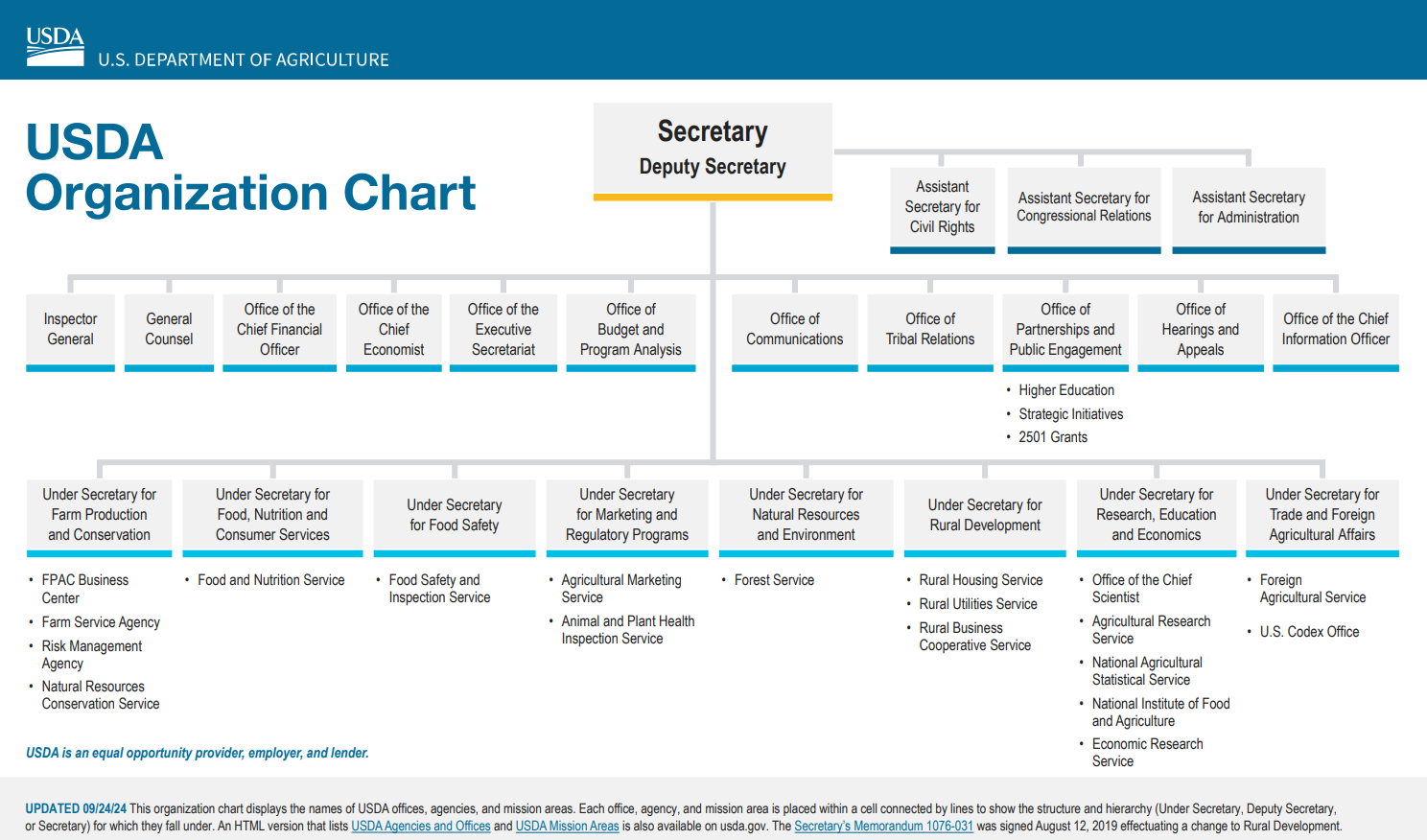
USDA Organization Chart — click to view full PDF
Quick Reference
Key USDA Agencies & Their Roles
USDA includes multiple agencies — each with a distinct mission. Here’s a quick guide to the ones most relevant to farmers and urban producers.
FSA — Farm Service Agency
Administers farm loans, disaster assistance, commodity support programs, and conservation reserve programs. Your primary contact for funding.
NRCS — Natural Resources Conservation Service
Provides technical and financial assistance for soil health, water quality, and conservation practices on working lands.
RD — Rural Development
Offers grants and loans for rural businesses, housing, and community facilities — including value-added agriculture and food hub projects.
AMS — Agricultural Marketing Service
Supports domestic and international marketing of U.S. agricultural products; manages organic certification cost-share and farmers market programs.
OUAIP — Office of Urban Agriculture & Innovative Production
Coordinates USDA urban agriculture initiatives, community gardens, and programs specifically designed for urban, indoor, and emerging producers.
usda.gov/urban-agriculture →
OUIAP Program Description →
OUIAP 2024 Program Application →
SARE — Sustainable Agriculture Research & Education
Funds research and education in sustainable agriculture; urban agriculture grants program supports urban and community food system projects nationwide.
sare.org/grants →
Sustainable Agriculture Research and Education (SARE) →
New SARE Bulletin: Best Practices for the Sustainable Urban Farm →
Quick Reference
Key Acronyms
Common FSA and USDA acronyms you’ll encounter across programs and documents.
RESOURCES
Explore More Tools & Resources
Navigation